IRITTY IN THE HISTORICAL LANDSCAPE
In the rapid march of transformation, the land, the people who knew its fragrance, and the cultural traditions and historical truths that emerged from them are gradually becoming alien to us. It may be said that the past of our panchayat was bound by social and cultural frameworks filled with diversity and challenges. The Keezhur-Chavassery Panchayat that we know today was, in its early days, two separate panchayats—Keezhur and Chavassery. However, this separate existence lasted only for a few years. Although factual information about the origin and growth of Keezhur is not readily available, the history of Chavassery has survived to a considerable extent without fading into mere legend.
There are various strong legends associated with the name Chavassery. One tradition holds that the sage Shathahoman performed penance here many decades ago, and that the place subsequently came to be known as Chavassery. Another legend says that the place where Shathahoma was performed in connection with the Kottiyoor Dakshayagam later came to be known as Chavassery.
This region, which was under the control of the Kottayam royal dynasty, was based on strong landlord–tenant relationships. Other feudal landlords under them subjected farmers to severe exploitation. The southern palace (Kovilakam) of the royal family was located at Chavassery and served as the centre for administering the region. The famous Sri Krishna and Shiva temples associated with the palace, along with the large temple pond, still exist today. However, even the remnants of the palace itself eventually became part of history.
Another important landlord was the Keezhur Idam Vazhunavar. Although they owned extensive tracts of land, conflicts arose between the Kottayam Raja and the Keezhur Idam Vazhunavar over control of Kariyadi Mala. In these confrontations, the military leadership on behalf of the Kottayam Thampuran was held by Karayi Kunhiraman, while that of Keezhur Idam was led by Karayi Pokkan. Keezhur Idam emerged victorious, and Kariyadi Mala came under its control.
The temples owned by the Thampurans, who had the authority to exile people and impose social restrictions, did not permit members of the lower castes to enter beyond the designated untouchability barriers. Different castes had separate bathing ghats in the temple pond. The punishments for violating such caste-based restrictions were extremely severe. Brutal forms of capital punishment included throwing people into Mannankund, where creatures resembling crocodiles were reportedly kept, and subjecting them to smoke torture. Other forms of punishment included confinement in Attakkund and the practice known as “Tholathuvachu.” These were only some of the harsh punishments of the time.
However, the first waves of the Temple Entry Proclamation of 1936 and the Malabar Temple Entry Act of 1946—which had far-reaching consequences in Kerala's cultural history—also reached these areas. Taking advantage of the legal provisions, the then social and political leaders N. V. Kunkan Nair and T. K. Narayanan organized members of the Karimpalan community and bathed in the temple pond. This became an event that had revolutionary consequences in the social and cultural history of Chavassery.
Following this, the temple priest met the Kottayam Thampuran and submitted a complaint. However, the then ruler, Shankara Varma Valiya Raja, realizing that the law was not in favour of the complainants, sent the priest back.
Historical remnants of the famous Malamakkavu Devaswom of that period still exist. Similarly, it is believed that there was once a fort at Keezhur as a symbol of royal rule; the name “Kottakunnu” (Fort Hill) still survives as evidence of this. A Shiva temple associated with the site is currently being renovated with the cooperation of local residents.
In the fertile soil, a large farming community worked hard and produced abundant crops, while conflicts arose between them and the landlords who enjoyed the benefits of their labour. Such exploitative relationships existed in Chavassery during the early period. In contrast, it may be said that the landlords had comparatively better relations with the farmers under Keezhur Idam.
The areas within our panchayat reflected the general character of Kerala society at the time, where an exploitative social and economic system prevailed. Like the Kottayam Thampuran and the Keezhur Idam landlord, the Koyilottara Tharavadu of UlIyil was also a powerful landed family. Families such as Erinjali and Puthiyaaramban were prominent old Muslim tharavads in the Punnad region. At that time, even the British police were reportedly required to visit Puthiyaaramban, obtain a signature, and return.
Practices such as Melcharthu (evicting the original tenants), Vechukanal, and the compulsory supply of cow ghee, vegetables, sugarcane/jaggery products and chickens caused great hardship to tenants.
Several agitations were organized during the period of British rule against exploitative practices such as Varam, Purappadu, Vashi, Nuri and Vechukanal. Ordinary people could not directly submit complaints to the police at that time; they had to obtain the permission of an official. One of the prominent officials of the period was Kottal Kuttyatha Haji.
While powerful agitations against British rule were taking place in other parts of the country under the leadership of the national movement, no major agitation under the national movement took place in our panchayat. However, our region had strong roots in the farmers' movement from the 1930s onwards. From 1935, the Farmers' Association began organizing strong agitations. Public meetings were held at Iritty, Keezhur, Punnad, Chavassery and surrounding areas.
Based on the Malabar Tenancy Bill of 1930, the Madras Government fixed the Maryadappattam (fair rent). Although this law was favourable to tenants, they were initially unwilling even to submit petitions to obtain its benefits. The Farmers' Association, therefore, organized agitations against the landlords while educating the tenants about their rights.
These agitations were led by Shankaran Nambiar and N. V. Kunkan Nair, who later became communists, along with K. K. Chathu Chettiyar, K. V. Nanumaraar, N. K. Govindan Nambiar and others. As a result, the varam was reduced from 100 seers to 60 seers. Standards for rent were also established. As part of this process, agricultural land was classified as first-grade, second-grade and third-grade land.
When the British Government imposed compulsory contributions to the War Fund in 1939, a protest public meeting was held at Mattannur on September 15 at the call of the Kerala Pradesh Congress Committee. Payyadakkan Shankaran Nambiar, N. K. Govindan Nambiar and N. V. Kunkan Nair from our panchayat participated in the meeting, were brutally assaulted and subsequently arrested.
Apart from these political and social leaders, it is also a matter of pride that industrialist A. K. Kadar Kutty and Justice E. K. Moidu were born and brought up in our panchayat.
Cultural History
Religious and cultural celebrations such as annual nerchas, as well as traditional Mappila art forms such as Kolkkali and Dafmuttu, have existed in this panchayat since ancient times. Processions and celebrations associated with important religious occasions have also traditionally been held in the panchayat.
The Othupalli system, an early form of religious education, was also established in the UlIyil area. Around 40 students studied religious subjects there at the same time, and many of them later became renowned religious scholars.
Religious and cultural celebrations such as annual nerchas, along with Mappila art forms such as Kolkkali and Dafmuttu, have been part of the cultural life of this panchayat from the early period. Processions and associated celebrations are held on important religious occasions. Each religious community has continued its own distinctive cultural activities in the panchayat.
Theyyam and Thira are popular festivals associated with worship and ritual practices. The week-long celebrations at Keezhur Sree Mahadeva Temple are a significant contribution to the cultural life of the panchayat.
Kalamezhuthupattu and Thottam Pattu are gradually becoming endangered traditions. Punnad's Kottani Krishnan Nambiar, who has received several awards, is a brilliant exponent of Kalamezhuthu and its associated songs.
There are numerous libraries and reading rooms that enrich the cultural life of the panchayat. The Payancheri Janakeeya Vayanashala, established in 1942, was the first library established in the panchayat. The library located at the panchayat headquarters was the second reading room.
These libraries and reading rooms have made significant contributions to literacy campaigns and public education. Numerous arts and sports centres have also been conducting cultural activities in different parts of the panchayat for many years.
In addition to libraries and reading rooms directly operated by the panchayat, there are also institutions run by local people's committees. Arts and cultural associations were formed in various parts of the panchayat many years ago under the leadership of local people interested in the arts and culture. Their objective was to promote mythological dramas and folk arts.
At present, more than 25 arts and sports associations are functioning commendably in different parts of the panchayat.
Construction of the Old Iritty Bridge
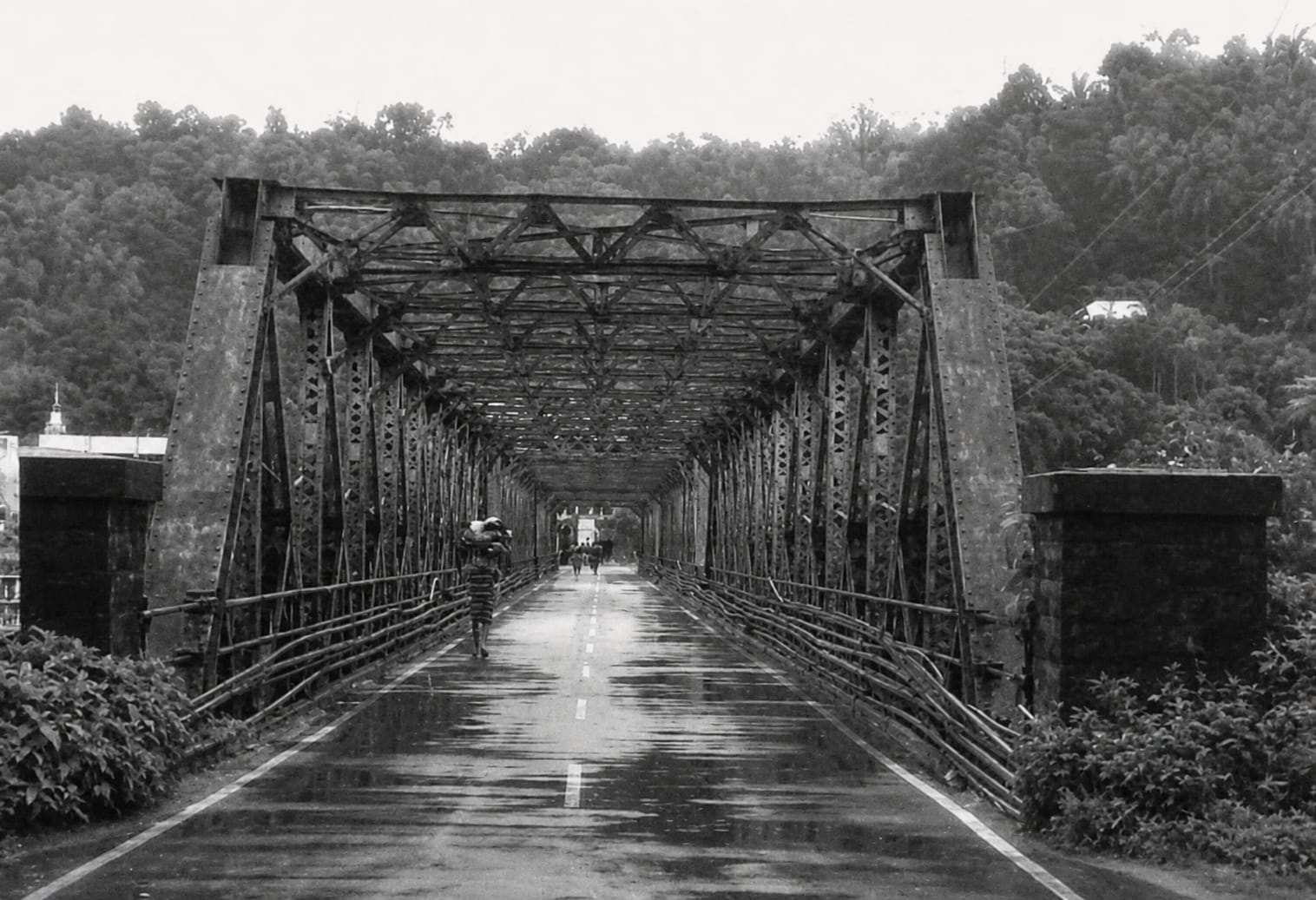
The Iritty Steel Bridge is one of the important bridges constructed by the British in British India. The first Iritty Bridge was built by the British in 1887. However, a few years later, the bridge was destroyed in the severe flood of 1928.
Following the destruction of the first bridge, construction of the present steel bridge began, and the bridge was inaugurated in 1933. The steel-girder bridge became famous because of the distinctive engineering technology used in its construction.
Built on two piers with three spans, the bridge was equipped with an effective vibration-control system. This made it an engineering marvel of its time.
The steel girders used in its construction were imported entirely from Great Britain. Mr. E. H. Stewart, one of the prominent bridge engineers of British India, designed and constructed this beautiful steel-girder bridge.
The British built the bridge across the Iritty River to connect the regions of Coorg (Kodagu) and Thalassery.
Keezhur-Chavassery Panchayat and Iritty Municipality
Although Keezhur and Chavassery were established as separate panchayats in 1955, they existed separately for only seven years.
In the early days, only people with a specified level of income had the right to vote. Voting was conducted by a show of hands, and women did not have voting rights.
The panchayats of that period had the powers of a civil court in administrative matters. However, because of insufficient revenue, they could not pay adequate attention to development and construction activities. Nevertheless, it is noteworthy that, within their limitations, they gave particular attention to constructing roads and bridges in rural areas.
The first President of Keezhur Panchayat was K. Kunjimadhavan Vazhunavar, and its Vice-President was Korothan Ananthan.
The first President of Chavassery Panchayat was V. K. Achuthan, and its Vice-President was M. K. Kunjikannan Nambiar.
According to a Kerala Government notification issued in 1961, the two panchayats were merged in 1963 to form the Keezhur-Chavassery Panchayat. A. K. Abdurahman became its first President, and N. V. Kunkan Nair became its Vice-President.
On November 1, 2015, Keezhur-Chavassery Panchayat was elevated to the status of Iritty Municipality. Shri P. P. Ashokan became the first Chairman of the municipality.
In 2020, the second municipal governing council came into existence, with Smt. K. Sreelatha serving as the second Chairperson.
In 2025, the third governing council of the municipality assumed office. Shri V. Vinod Kumar is the current Chairperson of the municipality.